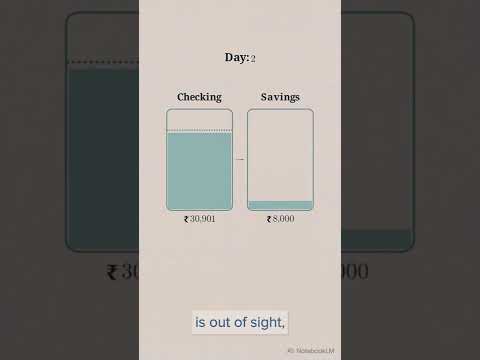
Most people save whatever is left at the end of the month — and by then, there's rarely much left. "Pay yourself first" simply flips the order: the day income arrives, move a fixed amount to savings before you spend on anything else, then live on the rest. Same salary, different sequence, a very different balance by year-end.
Here's how to set it up. Decide on an amount — say ₹8,000 if you earn ₹40,000 — and schedule an automatic transfer to a separate savings account for the day after payday. Now your savings happen first, on autopilot, and your spending naturally fits the amount that's left. You're not relying on willpower at month-end, when it's weakest and the balance is lowest.
Why does this work so well? Because spending expands to fill whatever is available. If ₹40,000 sits in your account all month, ₹40,000 tends to get spent. Remove the ₹8,000 up front and you simply adapt to ₹32,000 — usually without any real sense of sacrifice. The money you never see, you never miss.
A good starting target is 20% of take-home, but begin wherever feels comfortable, even 5%, and raise it whenever your income does. The point isn't to start big; it's to start in the right order. Once the transfer is automated, saving stops being a monthly act of discipline and becomes the default — the thing that happens before you've had a chance to spend it.